
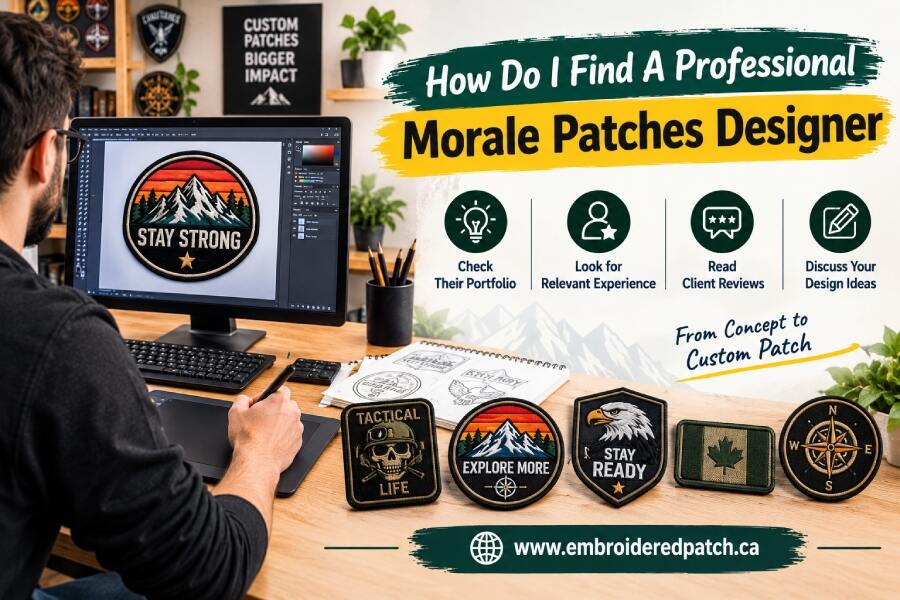
How Do I Find A Professional Morale Patches Designer
You may see a morale patch from a distance that can look simple. Up close, the difference between a professionally made patch and a rushed one can be obvious: fuzzy lettering, weak color contrast, uneven borders, or details that disappear after stitching. If you are looking to find the right designer, it is about more than choosing someone who can draw.
You should find a professional who can understand artwork, materials, embroidery, digitizing, and the practical demands of the finished patch. This blog walks you through practical steps to help you choose the perfect professional patch designer for making morale patches.
What Should You Look For In A Professional Patch Designer?
When you choose the right designer, make sure they can turn an idea into artwork that works when stitched. It is not enough to craft a polished digital image. Patch production also requires decisions about size, density, backing, stitch direction, borders, and readability. Current embroidery guidance has confirmed that these production choices can directly influence the finished appearance.
Steps To Find The Right Designer
You should use the following steps before you commit to a designer. This process can help you compare portfolios, avoid costly mistakes, and make sure your final patch looks as good in fabric as it did on screen.
1. Start With A Relevant Portfolio
You must look for previous work that can resemble your project. A designer who is experienced with logos cannot automatically understand tactical, uniform, club or morale designs. Ensure you examine close-up photographs instead of relying only on polished mockups. You must pay attention to lettering, small details, outlines and whether curves are still clean after stitching.
For example, if you want embroidery patches canada, you should check whether the designer has produced work involving similar sizes, colors and attachment methods. If a designer has a relevant portfolio, it can provide stronger evidence of capability than a generic claim of experience.
2. Ask About Embroidery Digitizing
This is one of the most important questions to ask the designer. Digitizing can help you convert artwork into stitch instructions that an embroidery machine can follow. It can also help you to determine stitch types, density, sewing order and other production details.
You should ask whether the designer creates files manually, reviews automated files or simply converts an image with software. Experienced professionals you are considering should be able to explain why certain details need to be simplified and how they will keep the design readable at its actual patch size.
3. Check Their Understanding Of Size
If a design is looking excellent on a computer screen, it can fail when it is reduced to three inches. Tiny lettering can often become crowded, narrow gaps close up and intricate illustrations lose their identity.
Your chosen professional designer should tell you when to enlarge, remove, or simplify an element instead of promising to reproduce every detail exactly. Current patch guidance specifically recommends using bold shapes, open spacing, and adequate sizing to keep the text readable.
4. Review Material And Backing Options
Ask the designer about the available fabric, border, thread, and backing options before you approve the artwork. Methods like sew-on, heat-seal, iron-on and hook-and-loop options serve different purposes, so your intended use should influence the design from the beginning.
This is specifically important for a morale patches maker that are working on pieces intended for bags, tactical equipment, uniforms or frequently handled clothing. Your finalized patch needs to look good, but you should prefer an attachment method that is appropriate for how it will be used.
5. Request A Digital Proof
You should never approve a large order that is based solely on a verbal description. Request a digital proof that shows the approximate shape, lettering, colors, dimensions, and overall composition.
If you get a proof, it gives you a chance to catch mistakes before production. Some established Canadian suppliers often advertise free artwork or proofing as part of their process, that show how this review stage can be useful.
6. Ask About Samples And Quality Control
You should find out whether the designer or manufacturer can provide a physical sample or sew-out before you order hundreds of patches. When you get a sample, it can reveal problems that a digital proof cannot. This can include thread buildup, weak contrast, puckering, or an edge that doesn’t look right.
If your project can involves police patches services, you should also confirm whether the supplier understands exact dimensions, lettering requirements, official colors and other specifications that are relevant to your organization. Some Canadian providers specifically advertise to use regulatory dimension matching and heavy-duty finishing for law-enforcement applications.
Questions To Ask Before Placing An Order
When you have a professional conversation with a designer, it should cover more than price. You should ask them about turnaround time, minimum quantities, thread colors, file formats, revisions, artwork ownership, backing options, sampling and what happens if the finished patches do not match the approved proof.
You should pay attention to how clearly the designer answers. Someone who is explaining trade-offs honestly is generally easier to work with than someone who is promising that every complicated design will look perfect without modification.
Things You Need To Know About Morale Patch Designers
1. How much will it cost to hire a custom morale patch designer?
The price of the custom morale patch designer depends on size, materials, stitch complexity, quantity, backing and whether new artwork or digitizing is required. You should ask for a complete quotation instead of comparing only the per-patch price. If you get a cheaper quote, it may exclude artwork, revisions, setup, shipping or sampling.
2. Which file format should I send to a patch designer?
It is useful to choose a vector artwork such as AI, EPS or SVG because you can scale cleanly. If you only have a PNG or JPG, you should send the highest-resolution version available. A professional designer can usually assess it and explain whether it is necessary to redraw or simplify.
3. How much time does patch design usually take?
If you are choosing a simple artwork, it may be prepared quickly, but detailed designs often require several revisions. Production of the patches can add another stage after approval. You should ask for separate artwork and manufacturing timelines, especially if you need the patches for an event, uniform rollout or fixed deadline.
4. Which one should I choose: embroidered or PVC patches?
The choice of the patches depends on the intended appearance and environment. Embroidery can provide a traditional, textured look, while PVC offers a smoother, molded finish and suits designs that need strong dimensional definition. You should discuss the use case with the designer before you choose the material.
5. Why is it important to ask for a physical sample?
A physical sample can show you how your artwork can behave as a real patch. It can reveal issues with thread density, color contrast, stiffness, tiny text, borders, and overall proportions that may not be obvious in a digital mockup.
Final Thoughts
When you’re looking for a professional morale patch designer, start by looking beyond attractive artwork. You should examine relevant portfolios, check how the design will behave at its actual size, ask about digitizing, review backing choices and insist on a proof before you start production. A physical sample can provide you with another valuable quality check before you commit to a larger quantity. Your goal should be to find someone who understands both design and manufacturing.

I am a creative blog writer at EmbroideredPatch.ca, where I share the blogs about expert insights, design tips, and the latest trends in custom patches and promotional branding. Our goal is to help businesses, clubs, and individuals turn their ideas into high-quality embroidered creations. Our content is written to uncover behind-the-scenes production knowledge, highlight expert design techniques, and share practical tips that help you create patches with confidence and creativity.