
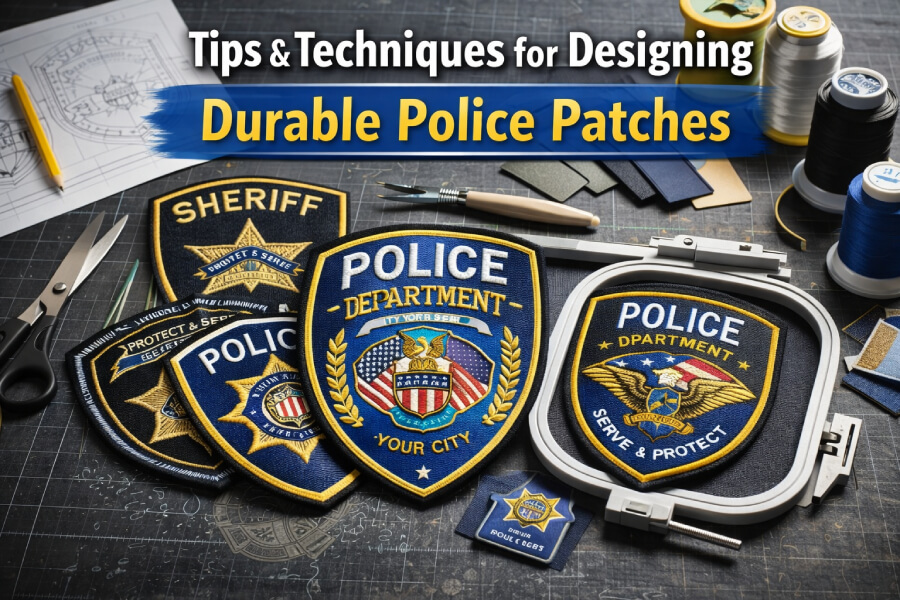
Tips & Techniques for Designing Durable Police Patches
The police patch, while made of fabric and stitched with yarn, symbolizes identity, authority, and pride. It can be a standard police patch or a specialized one, depending on the department or division. A well-crafted police patch tells a story in an instant.
However, beyond visual appeal, there is another important aspect to consider. Longevity. Badges must withstand harsh weather, repeated washing, and demanding field use.
Designing a police patch that not only looks impressive but also lasts for a long time requires a mix of artistry, material understanding, and technical expertise. How can we design these badges that not only look professional but also last a long time?
Understanding the Purpose of Police Patches
However, before moving into the design process itself, it is important to understand what a police patch does. A police patch is a symbol of trust and authority. Police officers use these badges every day, sometimes in very stressful conditions.
The design of a police patch should include key information, such as the department name, badge number, and symbols that represent the department’s identity. The design should also be recognizable from a distance. Simplicity is required over design complexity.
When you design with purpose, you ensure the patch remains relevant and practical, not just decorative.
Choosing the Right Materials
The durability of a design also starts with the materials. A good design is useless if the fabric and threads are not durable enough for heavy use.
One of the most commonly used fabrics for custom patches is high-quality twill fabric. This fabric is strong and smooth for embroidery. For harsh conditions, nylon and polyester are good options. These materials are strong and resistant to tears and water.
The threads are also important for durability. Polyester threads are better than cotton threads because they are resistant to fading, shrinking, and mildew. Polyester threads are also good for harsh weather conditions because they do not fade in the sun.
The backings of the badges are also important for durability. While heat-seal backings are convenient, they may not be durable enough for uniforms. Sew-on and Velcro backings are better options, especially for uniforms that need to be removed and replaced often.
Prioritizing Simple and Bold Design
When it comes to badges, less is more. A simple yet bold design is key to its visibility and durability.
Intricate designs, though appealing at first, can wear off sooner or even become unclear from a distance. Thick lines, clear fonts, and contrasting colors can help maintain visibility over time. It is also essential not to clutter the patch with too much detail.
Instead, stick to the most significant symbols such as badges, shields, or emblems. A well-balanced design can help in maintaining clear visibility over time.
Selecting Colors That Last
The selection of colors is not only related to the appearance. It is also related to the patch’s durability. Darker colors can be more durable than lighter colors.
Regarding the threads, colorfast threads can be used to ensure the patch does not change color. It is recommended to limit the colors used. Fewer colors can reduce the complications in the production process. It can also reduce the chances of fading.
In terms of contrast, high-contrast combinations, such as gold on navy or white on black, improve visibility and maintain a professional appearance.
Reinforcing Edges for Longevity
The most common failure in a patch, however, is along the edge, which can become frayed in no time, thereby damaging its look and functionality. Merrowed edges are a common choice for their durability. The thick, overlocked edge prevents fraying and gives the patch a professional look.
For complex shapes, a laser-cut edge with a heat-sealed finish provides a professional look and durability. The reinforced edges not only extend a patch’s lifespan but also maintain its professional look over time.
Optimizing stitch density and techniques
The durability of the embroidered design also greatly depends on the embroidery technique. Stitch density is a significant factor in ensuring the design is tightly knit and does not easily tear. Excessive density may cause the patch to become stiff and pucker. A good balance is essential for a durable embroidered design.
Stitching techniques such as satin stitching for borders and fill stitching for the design greatly improve durability and aesthetics. Double stitching of important design components, such as text and outlines, also improves durability.
Digitizing is another important factor for a durable embroidered design. A good digitization of the design ensures that stitches are made efficiently without putting pressure on the fabric.
Considering Environmental Factors
These badges have to withstand various conditions, such as heat, rain, dust, and constant movement. Designing police patches Canada to withstand these conditions can greatly enhance their durability.
In areas with humidity or rain, moisture-resistant materials should be used. For places in the hot sun, UV-resistant threads can be used to prevent color fading.
If the badges are intended for use in tactical operations, consideration should be given to low-visibility colors. Not only are these colors useful in operations, but they also tend to last longer.
Ensuring Proper Attachment Methods
The manner in which the patch is attached to the uniform can impact its lifespan. Sew-on badges are the most secure type of patch. They can withstand repeated washing and heavy use without detaching from the uniform.
Velcro patches can be very useful for tactical forces. However, the Velcro itself should be of high quality so that it does not lose its stickiness over time. Reinforcing stitching along the Velcro edges can help extend the patch’s lifespan. It is not recommended to use adhesive to attach badges, as it tends to deteriorate over time.
Testing and Quality Control
Before making a final decision on a design, testing is a necessity.
Prepare a number of badges and put them through real-life conditions. This includes washing them multiple times, exposing them to sunlight, and testing their durability to wear and tear.
This also help identifying problems such as color loss, thread loosening, and frayed edges, enabling appropriate adjustments to meet durability requirements.
Quality checks also involve inspecting each batch of badges to ensure consistency, as even slight differences can affect their performance and appearance.
Balancing Tradition with Modern Techniques
Personalized logo patches sometimes have a sense of tradition, but with modern technology, there are ways to make them more durable.
The use of laser cutting, embroidery machines, and durable materials can result in more accurate, long-lasting designs. Adding these technologies to police badges will not detract from their traditional essence but will add to it.
You can mix traditional design elements with modern technologies to create badges that are both traditional and long-lasting.
Frequently Asked Questions
- What is the most durable material for police patches?
The best material for these badges is polyester fabric with high-quality polyester thread. This material is highly durable as it does not fade, shrink, or get wet.
- Are embroidered patches more suitable than printed ones for police purposes?
Yes, embroidered badges are more suitable than printed ones for police purposes. This is because embroidered badges are more durable than printed ones.
- How do I keep my police patch from fading?
To keep your police patch from fading, use UV-resistant thread, choose dark colors, and wash the patch properly.
Conclusion
The art and science of creating long-lasting badges. It involves proper planning, proper materials, and proper attention to detail. It starts with proper fabrics and threads, and ends with proper simplicity and techniques. It all counts towards the patch’s longevity.
A well-made police patch not only symbolizes a department but also lasts alongside the officers who proudly display it. Proper planning for longevity means your design will not only stay sharp and proper, but also remain relevant and meaningful.